Introducing a familiar face to some of my fellow pony pals:
Dr. Zitzmann please introduce yourself!
“I was born and raised on Long Island NY and have been an equestrian since I
was 8 years old. Throughout my high school years I was a working student for
hunter/jumper barns as well as a varsity track runner, until I started college at Cornell
University. I was a member of the Division 1 equestrian team there as an animal
science/pre-vet major. I decided to stay in the cold upstate NY weather for vet school at
Cornell as well (but I will say the summer/fall weather made up for the winters!!). After
graduating vet school in 2022, I did a rotating equine exclusive internship at Fairfield
Equine in Newtown, CT, where I was immersed in all aspects of equine medicine
including sports medicine, surgery, general practice, and emergencies. I also got to
spend a couple of months working in Wellington FL during the winter show season.
After completing my internship, I was ecstatic to return to Long Island as an associate
veterinarian for Grand Prix Equine in summer 2023. I am currently loving every second
of it!”
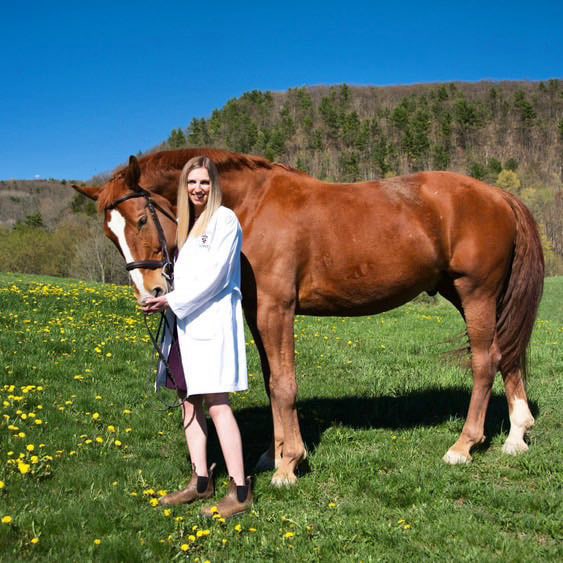
Have you always wanted to be a vet? What drew you to the career?
As a lifelong animal lover and lover of school/science, veterinary medicine has
always been a dream for as long as I can remember. When I started shadowing vets at
a young age and seeing how the job is just as much helping people as it is helping
animals, I was officially hooked.
What kind of riding do you do?
I’ve mostly ridden hunter/jumper, and focused more on equitation while I was in
college riding IHSA. As a vet student, I dabbled in some eventing which was a change,
and cross country might have been the most fun I’ve had on a horse! Currently, I am
leasing a horse that is more of a jumper/equitation type and I absolutely love him.
In your veterinary opinion what is best – polo wraps, boots or nothing?
A poorly wrapped polo wrap can cause an issue such as a bowed tendon, as we all
probably learned in pony club/pony camp growing up. Wraps should only be applied if
the one wrapping is educated! Other than that, I truly don’t have a preference!
For my own horse that I ride, if I am just flatting, I don’t have anything on his legs.
If I am jumping, I do put boots up front and polo wraps behind. He also gets turned out in
boots.
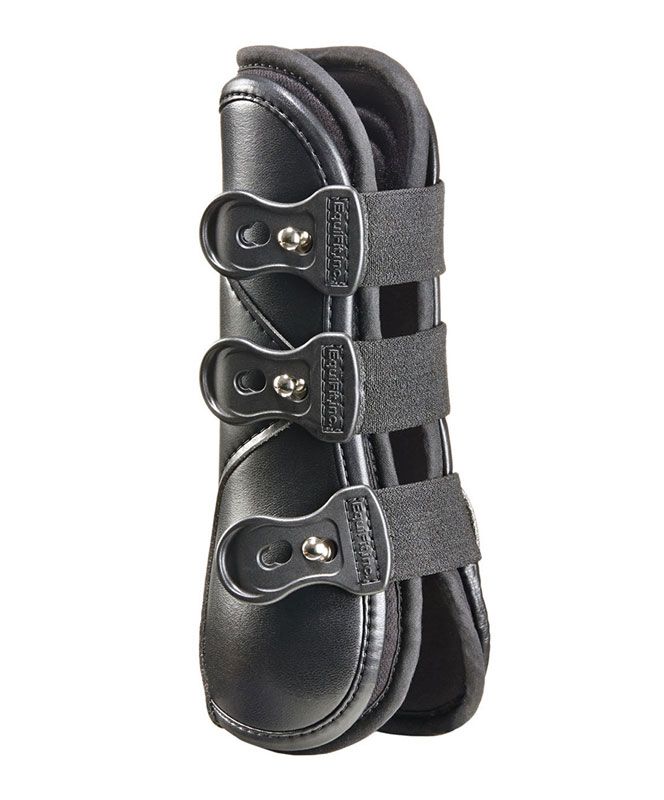
Amy here: I currently horse show and school in the Equifit Eq-Teq front boots. I think they are extremely versatile so I use them in both the equitation and jumper rings! The unqiue thing about these boots are the liners!
“ImpacTeq Peel Away Liners transform from soft to rigid upon impact, mold to the leg for a perfect fit, are breathable and therefore cooling, all while promoting circulation.
The ImpacTeq Peel Away Liner has removable cubes in targeted zones which allows you to remove small or large sections of the liner as needed. ImpacTeq Peel away liners are ideal for horses with uniquely shaped legs, existing growths or wounds, or other hard-to-fit issues. ImpacTeq Peel Away Liners alleviate pressure and ensure the most custom and comfortable fit possible. “ – They are quite pricey, but because I use them in jumping lessons and while competing, I do think I get plenty of use out of them to make them worth it. I am also the no boots/wraps for flatting girl, and I do try to remove my boots as soon as I’m done jumping.
BOOTS: EquiFit Eq-Teq Front Boot
Were you able to keep riding while in veterinary school?
Since I went to vet school at the same school as my undergraduate, I had
connections with the equestrian program and thankfully was able to keep riding! I
helped the coach exercise horses when needed, especially over school breaks when
the undergrads were away, and was able to help out at the IHSA shows by warming the horses up. I also happened to be a vet student during the COVID pandemic. When we moved to online class, it allowed me to go ride a couple of horses in the morning and then do all of my schoolwork in the
afternoon/evening, which helped me focus even more!
What is the one thing you wish owners did or knew about horses or vet care?
Your veterinarians’ truly love being a part of your team! I can speak for myself and
my colleagues in the practice I work for, that being included in all conversations
regarding the horse’s care gives us the best opportunity to help you. That way, we know
the horse well enough that even very subtle changes can be quickly addressed and
treated to keep your horse feeling their best! We love videos as well- if you notice
anything with your horse doing something different either under saddle or on the
ground, even if it’s super subtle, grab a quick video and send it. Sometimes we
show up and the horse looks normal even though you swear they felt off the day before!
(it’s happened to me many times!) 😉
What is the one veterinary medicine or tool/product that all horse owners should have
on hand?
Everyone should definitely at least have a tube of Banamine on hand. Sometimes
if your horse is colicking, I may be with another emergency or located far away, so
keeping the horse comfortable in the meantime is imperative!
What is one household product that you use in your everyday vet practice?
Disinfectant scrubs and isopropyl alcohol! Every sterile procedure that we do
starts with a thorough scrub first to prevent any secondary infections.
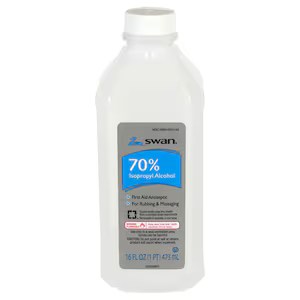
Amy here: I buy these small bottles at the Dollar tree for $1.25! They are small enough to keep in your locker, trailer or tack trunk. You can make it even easier and use an old spray bottle nozzle and screw it right onto the bottle. Better yet if you have a HSA/FSA through your employer – this is an eligible item!
So using horse girl math, this is free!
Do you have a favorite memory or story of success?
Every time one of my patients is able to get back into the show ring after a
lameness issue or illness, it makes my heart warm!
What is the difference between ulcerguard and gastroguard?
The concentration of omeprazole is exactly the same in both ulcergard and
gastrogard- it is just the dosing/purpose that is different. Ulcergard is marketed as an
ulcer “prevention” medication while gastrogard is an ulcer “treatment” medication.
Typically, ¼ tube ulcergard will be given daily during any sort of stressful event for an
ulcer-prone horse (shipping, shows, etc). Whereas, 1 full tube of Gastrogard is given
daily for treatment of gastric ulcers that were diagnosed on a gastroscopy exam.
What is the most difficult part of your job?
Of course, euthanasias are difficult and the worst part of the job; but also it is
always a kind, empathetic decision if the horse is suffering. Difficult
lamenesses /diseases that require a lot of diagnostics or referrals to a specialists can also
be frustrating in the moment, but so rewarding when the problem is figured out and
treated.
Do you still have time to ride while working as an equine vet?
I make time! I am so lucky to have flexible trainers, and a flexible owner of the
horse I lease. They all completely understand if I need to reschedule a lesson or ride due to an
emergency.
Is there anything you’d like to learn to advance your career in the next 5 years?
There are more and more options for joint injections that are hitting the market
and I plan on continuing to educate myself on these options! The traditional joint
injections with steroids are what everyone has been using for years, but we know now
that repeated steroid injections actually degrade the joint over time (although it does
provide short-term relief.) Trying to educate clients and myself on the other options like
biologics/stem cells, polyacrylamide gels, amnion products, etc. will only promote equine
well-being for the future!
What is the one thing you did before becoming a vet that you would never do now as a
vet?
In general, I am actually more cautious around horses now than I used to be
before becoming a vet. Throughout my career, I have seen otherwise perfect horses act
out in unexpected ways when they are scared/hurting.
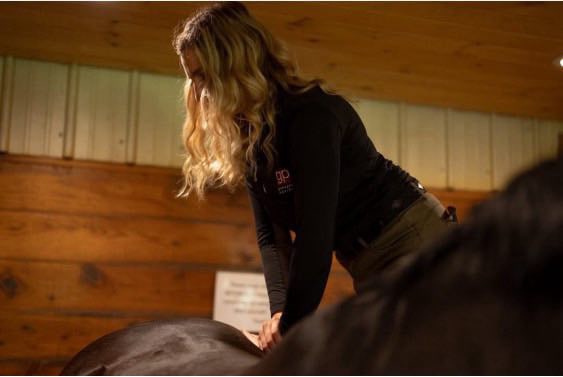
You are also a chiropractor? How did you become that?
I am, and I love it! There are certification courses available that require a DVM
degree, so I decided to get certified in fall 2023 through a program called Options for
Animals. Chiropractic care is an excellent adjunct to traditional veterinary medicine and I
use it frequently in my practice.
For my pre-vet hopefuls, or my ammy friends who are sick of their desk job and are strongly considering a career shift:
I want to be an equine vet, what three things should I do before applying to vet school?
- Shadow or work for an equine vet and get a good letter of recommendation
from them! This will also allow you to see if this is really something you can
see yourself doing, as there is a lot of time and money that goes into
becoming a veterinarian. - Try to get other experiences as well, e.g. working with a variety of other
animals/other extracurriculars/etc- vet schools like to see diversity! - Make sure you take, and do well in, all of the prerequisite classes required by
veterinary school admissions.
Do you think experience riding horses makes you a better at being an equine vet?
Yes I think it definitely does. Being able to relate to my clients when they describe
what they are feeling as a rider is very helpful.
PLEASE MAKE SURE TO ALWAYS THANK YOUR VET! WE WOULD BE NOTHING WITHOUT THEIR CARE AND SUPPORT!! A SPECIAL THANK YOU TO MY WONDERFUL VET DR. AIMEE EGGLESTON OF EGGLESTON EQUINE!


 Three Ring Eq
Leave a comment