It’s that time of year! The summer show season is coming to an end! We are wrapping up the end of the summer and slowly making our way into indoor finals and indoor riding in general. Many of us are familiar with passing “left shoulder to left shoulder”, but things can get a little sideways when we are in the warm up ring or we are rehabbing our young horse while someone is taking a lesson on their fiery jumper. So what are the other “rules”? And is there a time to NOT do left shoulder to left shoulder? Here are some ring etiquette rules to try to live by.
Lessons Get Priority with Exceptions
If someone is having a lesson, that lesson has priority if you are at home. Although it may feel very easy to jump along with that lesson on your own, it’s always best to ask. Talk to that trainer and see how they feel about you rotating in to jump a few jumps. It’s much like working out at the gym and alternating with a partner on a machine. When that person has done their “set”, they get up and let the next person have a turn. When that person is done, they can go back in and continue on.
The lesson will determine the jump height. Although you may not need to jump 2’ today, that lesson might – and trying to adjust the fences between riders may take too much time between rides. If your horse ends up knocking a rail, that time the trainer is fixing the rail, is time away from the rider who paid to jump around today.
If you are flatting around, it may be helpful to ask the trainer what the path/course is for that lesson. Ask where you can be to stay out of the way (often times it’s the rail). There is usually some down time between courses, so if you so choose – hang out of the way just for the minute or two the rider is on course, and then resume your flat work when they go to take a walk break.
Lessons will take the priority unless you are lessening in the warmup ring of the horse show.
The Horse Show Warm Up – Flatting
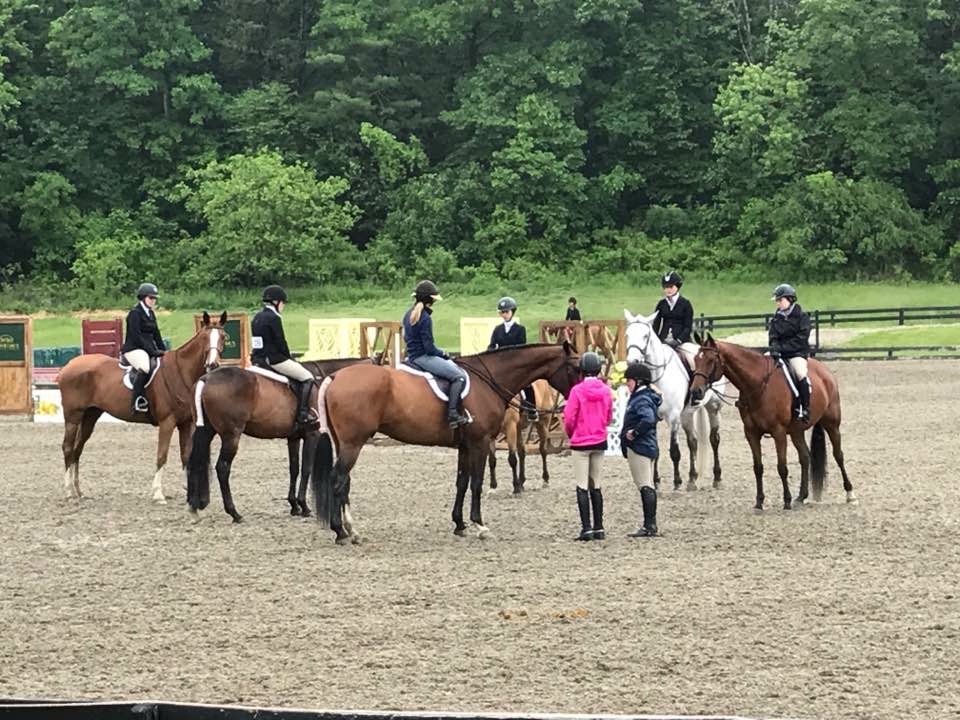
The horse show warmup is truly the gauntlet when it comes to “riding in traffic”. This is where the pecking order changes slightly in which the riders warming up to compete should get priority. Ideally you are not hacking or having a lesson in the same ring at the same time as the riders getting ready to compete in a class – but that’s how it works out sometimes.
Many of the same flatting rules apply including left shoulder left shoulder to pass in opposite directions. Ideally (although not required) it’s helpful for the flow of traffic if the majority of riders are going in the same direction. A second rule of thumb would be that faster traffic is passing to the inside. So if you’re cantering and the majority of the ring is trotting, you can count to stay on the inside track. If the opposite is true and you’re going slower than the majority of traffic, stay to the outside track.
Depending on what horse show you’re at , the warm up ring may be the equivalent to a large lunge ring, or similar to a regular sized show ring. When passing horses whether that be to their inside or in opposite directions, do your best to give a good margin of space when possible. Passing very closely is just not a necessary risk to take if you have the room to avoid it. Communication is key and letting riders know you’re on their inside or outside helps to prevent a traffic jam of sorts.
The Horse Show Warm Up – Jumping
When it comes to jumping in the warm up ring, the same rules apply – the individuals getting ready to compete have the priority. For those not competing, you may ask to rotate in on a jump as you would at home. If they are warming up for the short stirrup, you may need to warm up for the short stirrup until they abandon their jump to go elsewhere. Look out for marked standards with red and white flags. The rule is that you want the red on your right while jumping the jump. This prevents a nasty collision of two riders jumping the same jump from opposite directions at the same time.
Although not a rule by any means, I do find it a little unnerving personally when I am cantering up to a warmup fence and I can see someone cantering a few feet right next to me, or coming down to the fence next to me from the other direction. Much like golf, everyone is quiet and doesn’t make sudden moves or sounds until the golfer has swung his club. If avoidable, I personally try to not jump jumps directly in time with someone else if we are jumping jumps that are side by side. Horses rarely have this happen in any other scenario and it can be both unsettling for horse and rider. Sometimes the timing is perfectly imperfect, but if you look up and see someone just stepping off into canter – just waiting a second or two before you also canter may help stagger your jumps.
Where Should I Be? The Inside or the Outside Track
In theory the riders on the inside track are going faster than the riders on the outside track. The riders who are jumping want to be as close to where the jumps are set (normally across the center of the ring), so that they don’t have to turn through traffic to get to their fence. When possible, riders who are jumping should be on the inner most track. Depending on how many riders are riding in how many different directions this can prove to be challenging.
For Riders Jumping: If you are the rider who is jumping – do you best to stay on the inner most track without compromising the line to your fence. Make sure to call where you’re going AND LOUDLY, so you can warn other riders, and potentially allow them time to get out of your way. Worry both about the path of the approach of jump as well as the path to canter away from the jump (as you need both sides of the runway).
The number one rule ultimately is safety. So if you can’t get to your jump without zig zagging or that short stirrup pony just dumped the pony kid in the same corner you needed to use to turn – just circle and re-approach – it’s not worth putting a bad jump on your horse. Patience is key.
For Riders Not Jumping: If you are not a rider who needs to jump fences in that ring – it maybe better to potentially move rings so you don’t have to worry about being in the way of jumps. If you need to be where you are, do your best to stay as far away from the fences across the center of the ring as possible. I’ve seen too many riders change directions and completely cut off the approach and landing side of the jump. There have been times I’ve changed directions to go with the flow of “jumping traffic”, tucked myself in the corner, purposefully cut off a corner – do whatever I needed to do to try to give that rider who is jumping, the right of way. Please do not park yourself in front of a jump to fix your stirrups, or walk on the inside track side by side with your barn mate. If you’re done, try to leave the ring. If you need to stick around, walk on the outermost track until you are able to leave.
Right of Way to the “Having a Bad Day” Horses
There are many both spoken and unspoken rules of ring etiquette. I think the number one rule I have is disregarding all the “rules” if safety is at risk. Safety is always the number one concern always, but especially when riding in the ring with others.
Red ribbons in the tail notoriously mean this horse may kick, or does not appreciate other horses following closely behind. Red ribbons in the front/attached to the brow band mean that this horse does not appreciate head on traffic, so pass cautiously from opposite directions. There’s a lot of other ribbons that mean different things – but what if there’s no ribbon? Nothing to warn us?
Well lucky for us, most horses will absolutely tell us when they are not having a great day, and there’s no ribbon warning needed. My rule of thumb is any horse I see bucking, rearing, bolting, kicking or any other aerial activities, will get double the space of other horses in the ring. If their horse becomes severely ”unraveled”, I may pull up or change paths or even change rings to get out of their way. If you’ve seen this horse bolt on the landing side of the fence and the rider had to use the fence to get that horse to stop….you won’t find me anywhere near the landing side of that fence.
Long story short, on a good day we can’t guarantee horses will do what they’re told. This is what makes this sport so unique, exciting and often times difficult. On a BAD DAY, we FOR SURE can’t guarantee horses will do what they’re told. The rider may have had every intention to stay to the inside track, but needs to continue to turn her horse into the rail to slow down. A rider may be trying to avoid blocking the path to a jump, but their horse is spooking at the loud speaker and bolting toward the middle of the ring to be close to their stallmates. Never assume everyone will “obey” traffic laws in the ring, but especially not when a rider may have their hands full.
These are some simple “riding in the ring” etiquette rules. Although I’m sure there are many others, here are some other things I consider to be polite and respectful of shared space.
- Close the gate if you found it closed
- If you set poles/jumps, take everything down and return it to the way you found it – unless given permission
- If you’re leaving a rider alone in a ring, ask them if they will be okay alone. Many horses are extremely herd bound and can become distressed when they are in a ring with other horses and then they are alone – especially if they can watch the horse leave to go back to the barn.
- If lights were off, turn them off before you leave.
- If you’re not sure you’re allowed to use certain equipment/jumps, you should wait until you know for sure.
- If you’re required to pick up your own manure after riding, make sure you do.
- Announce your arrival especially if you need to open a gate to let yourself in. A horse “suddenly appearing out of thin air” can easily spook other horses. Making your presence known allows riders to change their path, pay attention – especially if the entrance of your ring is obscured which can be spooky to horses already in the ring.
Riding in shared spaces can be challenging. Be a pleasure to ride with! Be safe, eyes up and “sorry!” can go a long way. Ultimately we can’t always be right 100% of the time, so if you accidentally cut someone off, spook their horse, pass going the wrong way – a simple wave and a “my bad” is probably the best ring etiquette there is!
So get out there, draw an L on your glove if you have to, and have fun 🙂




 Three Ring Eq
Leave a comment